
Floating Lab Fights Invasive Marine Species

1oo Stories Impact To help stop invasive species from hitching rides in ships’ ballast water and damaging local ecosystems, scientists at the University of Maryland Center for Environmental Science created a one-of-a-kind floating lab—a 155-foot barge that can travel around the Chesapeake Bay testing new treatment technologies. This mobile lab, part of the Maritime Environmental […]
A Trailblazing Woman Behind Chesapeake Science

1oo Stories People When Carolyn Keefe began her career at the University of Maryland Center for Environmental Science (UMCES) in 1967, being a woman in science meant navigating a field that didn’t always make room for you. Hired as a faculty research assistant—alongside a male colleague with identical qualifications—Keefe learned she was paid significantly less. […]
Grateful for Philanthropists Brian Hochheimer and Margie Wax

1oo Stories Impact We are deeply grateful to Brian Hochheimer and Margie Wax for their generous $1 million donation to establish the Chesapeake Biological Laboratory’s (CBL) first-ever endowed professorship, honoring Tom Miller, CBL’s former Director. This transformative gift will help attract top-tier faculty and advance cutting-edge environmental research. Brian and Margie’s long-standing support for CBL, […]
Pioneering Book Sheds Light on Microplankton and Aquatic Ecosystems

1oo Stories People Dr. Pat Glibert, a leading scientist at the University of Maryland Center for Environmental Science (UMCES), addresses a critical gap in aquatic microbial ecology with her book Phytoplankton Whispering: An Introduction to the Physiology and Ecology of Microalgae. This comprehensive work explores the history, diversity, and environmental impacts of microalgae, the microscopic […]
Ben Fertig, Ph.D. – 2010 Alumnus Making A Positive Impact

1oo Stories Impact https://umces100.org/wp-content/uploads/2025/05/BenFertigVIdeo.mov Read More
New President Advancing UMCES’ 100-year Legacy

1oo Stories Leadership The University of Maryland Center for Environmental Science (UMCES) welcomed Dr. Fernando Miralles-Wilhelm as its new president in July 2024. A renowned hydrologist and environmental scientist, Dr. Miralles-Wilhelm brings over 25 years of global experience in water resource systems, climate change, and ecosystem sustainability. Throughout UMCES’s centennial year, Dr. Miralles-Wilhelm is focused […]
From Humble Beginnings to Global Leadership

1oo Stories Moments In 1973, a small metal building on the shores of the Chesapeake Bay became the birthplace of oyster restoration at the University of Maryland Center for Environmental Science (UMCES). The original hatchery was a modest space, shared between striped bass and oyster research, equipped with only four tables and a few small […]
A Career Sparked by a Storm

1oo Stories People Jeff Cornwell, a faculty member at UMCES for 39 years, began his journey into science coincident with a storm—Hurricane Agnes in 1972 occurred during his high school graduation. A college geology course showed him the devastation the storm left on the upper Chesapeake Bay watershed. Years later, after research in Alaska and […]
The New Generation of Leaders

1oo Stories Vision Throughout its history, UMCES has graduated hundreds of new environmental leaders. Today’s UMCES alumni are able and eager to take on the mounting challenges facing our natural world. Here’s just one example of an UMCES alum making a difference. Read More
The Bay Gets a Grade
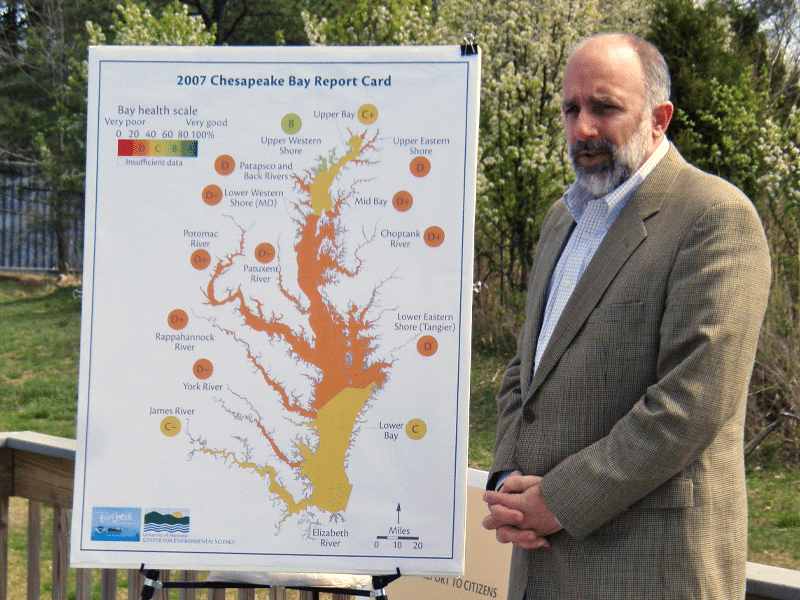
1oo Stories Moments In 2007, UMCES Integration and Application Network released the first Chesapeake Bay Report Card. Take a look at how far we’ve come. Read More


